
What is Par in Golf? Par 3/4/5/6 Standards, Scoring & Strategy 2026
Time 15/05/2026
Par in golf is the standard number of strokes a scratch golfer (Handicap Index 0.0) is expected to need to complete a hole or an entire 18-hole round under normal playing conditions. This is the most fundamental concept for assessing player skill, course design, and scoring in golf.
In this article: Par definition per R&A/USGA · Yardage thresholds for Par 3/4/5/6 · Scoring terminology (Birdie, Eagle, Bogey...) · Professional scorecard reading · Par and WHS Handicap relationship · Vietnam course Par data · Strategy by Par type
1. Official Definition of Par (R&A & USGA)
According to the R&A Rules of Golf 2023-2026 and USGA, Par reflects a hole's difficulty based on length and terrain obstacles. Par implicitly includes two putts on the green; the remaining strokes are those needed to reach the green from the tee box (Green in Regulation – GIR).
Par is not an absolute fixed number. The Course Committee may adjust Par based on slope, prevailing wind direction, and hazard placement. The same hole may be Par 4 for men but Par 5 for women due to differences in average driving distance.
Etymology of "Par"
The term "Par" originates from Latin meaning "equal" or "equality." Before entering golf, the word was used in finance from the 16th century to describe the face value of stocks. In 1870, Alexander Hamilton Doleman (Scotland) first used "Par" to describe the ideal score at the Prestwick championship. The USGA officially codified the Par rating system in 1911.
2. Yardage Guidelines for Each Par Type
The USGA Course Rating System (Appendix F: Establishing Par) provides standard length thresholds for determining Par. These parameters apply at elevations below 2,000 feet (~610 meters) above sea level. At higher elevations, yardage thresholds may be extended.
Source: USGA Appendix F – Establishing Par (2023-2026). When a hole's length falls in the overlapping zone (e.g., 470 yards for men), the Course Committee decides Par 4 or Par 5 based on design intent, fairway width, and bunker placement.
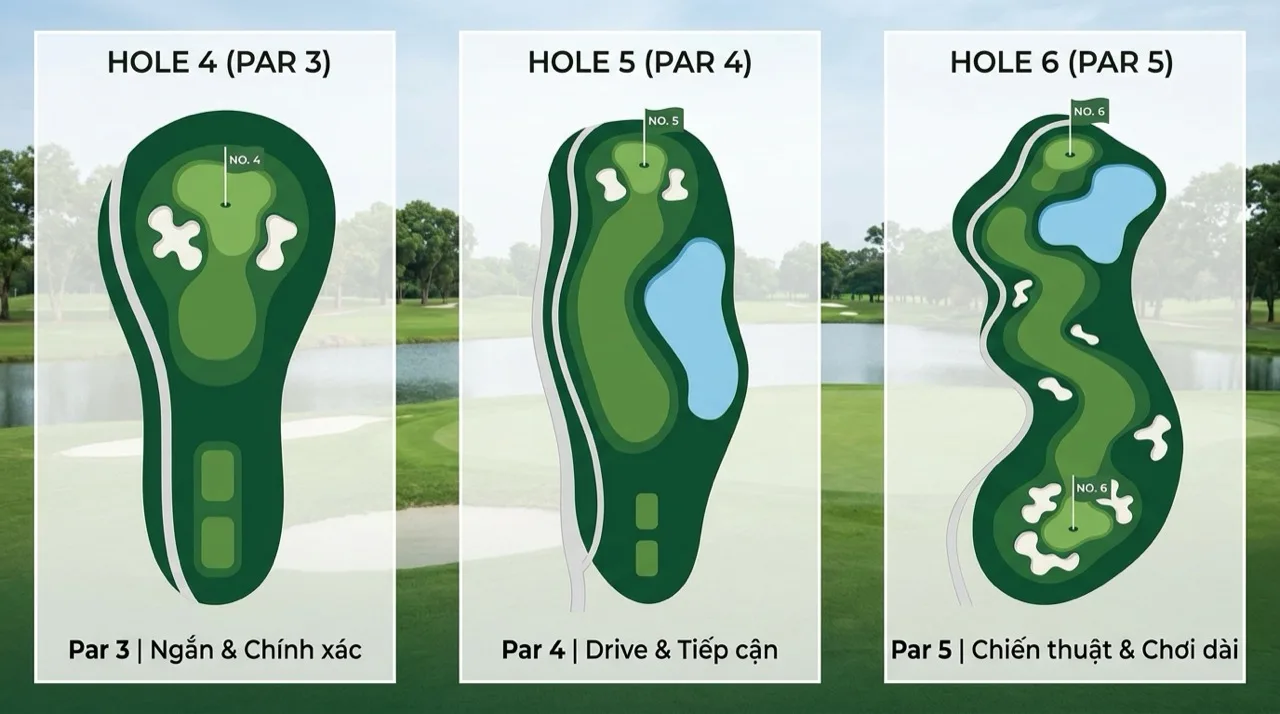
Par 6 – Do They Really Exist?
Par 6 is the rarest hole type but does exist. To qualify as Par 6, a hole must exceed 670 yards. Worldwide, about 5 courses feature official Par 6 holes:
Remarkably, Gunsan Country Club (South Korea) features a Par 7 hole at an astonishing 1,097 yards. Sources: GolfPass, MyGolfSpy (2025-2026).
3. Scoring Terms Relative to Par
Golf's scoring terminology serves as a universal language for golfers to communicate performance precisely:
4. Standard Par for an 18-Hole Course
The total Par of an 18-hole course equals the sum of each individual hole's Par. Most full-size courses have Par between 69 and 74, with Par 72 being the most common for professional tournaments.
Standard Par 72 layout: 4 Par 3s + 10 Par 4s + 4 Par 5s. This classic configuration balances short holes (Par 3 – Birdie opportunities), mid-length holes (Par 4 – testing all skills), and long holes (Par 5 – the challenge of power and strategy).
5. How to Read a Professional Scorecard
A scorecard is more than a scoring sheet – it is a miniature tactical map of the golf course.
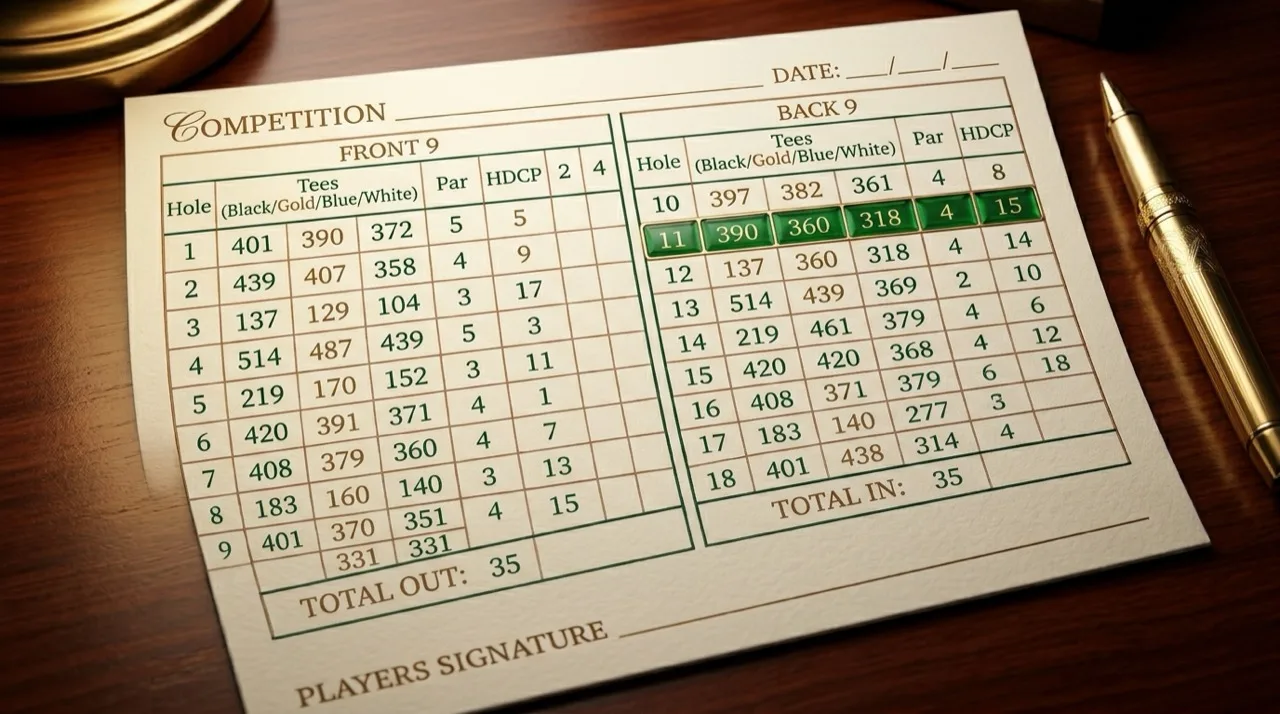
Meaning of Stroke Index (SI)
Per WHS 2026, Stroke Index is allocated using the Triad principle (groups of 3 holes) so the hardest holes are not clustered together, creating fairness in Match Play. Typically, odd SI numbers fall on the Front Nine and even SI numbers on the Back Nine.
Real example – BRG Kings Island Front Nine (Kings Course):
- Hole 8 – Par 5, 540 yards, SI 1: Hardest hole on the front nine
- Hole 4 – Par 3, 148 yards, SI 17: Easiest hole, great Birdie opportunity
6. Par and Handicap – The WHS Connection
Since the World Handicap System (WHS) was adopted globally, Par and Handicap have become tightly linked through the Handicap Differential formula:
Handicap Differential Formula
Differential = (113 ÷ Slope Rating) × (Adjusted Gross Score − Course Rating − PCC)
Where: Course Rating = expected score of scratch golfer; Slope Rating = relative difficulty (standard = 113); PCC = playing conditions adjustment (-1 to +3)
Example: You shoot 85 on a Par 72 course with Course Rating 71.2 and Slope 130 (PCC = 0): Differential = (113 ÷ 130) × (85 − 71.2) = 0.869 × 13.8 = 12.0. While you shot +13 vs Par, the challenging course (Slope 130) means your performance equals a 12.0 Handicap.
Course Rating & Slope Rating in Vietnam
Source: VGA / vHandicap (2025-2026).
7. Vietnam Course Par Data
In Vietnam, most standard golf courses have Par 72. A few distinctive courses feature Par 71:

Longest Par 5 Holes in Vietnam
- Hole 5 – Ba Na Hills Golf Club: 708 yards – Vietnam's longest Par 5
- Tuan Chau Golf Resort: Par 5 at 711 yards from Black Tee
- Hole 3 – Montana Golf Course: Par 5 at 617 yards, stunning downhill
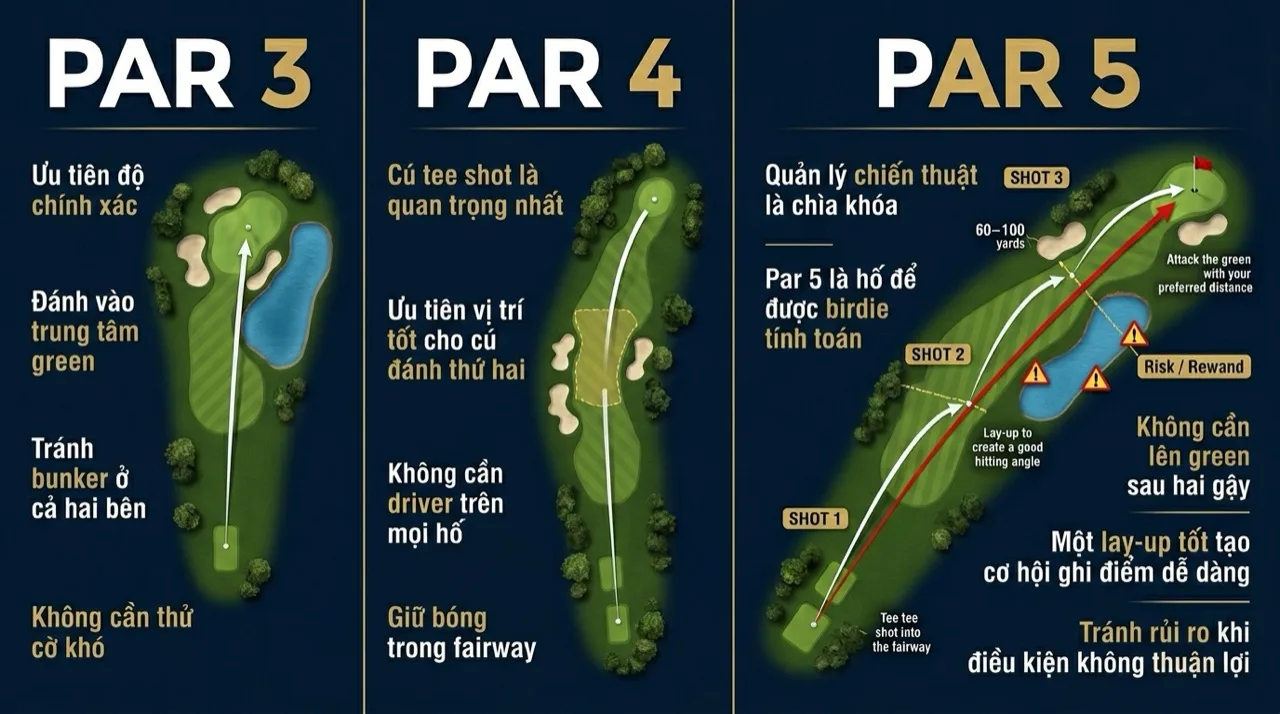
8. Strategy Tips by Par Type
Par 3 Strategy – Safety First
Always select a club that comfortably reaches the center of the green, not your maximum distance. The biggest mistake is coming up short into front water hazards. Even a 5-Handicap golfer only hits GIR 39% of the time from 150-200 yards. Aim for the widest part of the green rather than attacking a tight pin.
Par 4 Strategy – Tee Shot Sets Everything Up
Prioritize finding the fairway over maximum distance. The approach angle from the fairway matters far more than gaining a few extra yards in the rough. If you cannot reach the green in regulation, play it like a short Par 5 – lay up to your preferred distance and hope for a one-putt Par save.
Par 5 Strategy – The Scoring Opportunity
Only attempt going for the green in two if you have hit a great tee shot and the area around the green is safe. When laying up, position your second shot to leave your favorite wedge distance (e.g., 100 yards). This is where low-handicap golfers capitalize for Birdies and Eagles, while beginners often lose strokes by overswinging.
9. Pro vs Amateur Statistics
Source: PGA Tour Stats 2025, National Golf Foundation.
10. FAQ – Frequently Asked Questions About Par
What does Par 72 mean?
Par 72 means the total standard strokes for all 18 holes is 72 (4 Par 3s + 10 Par 4s + 4 Par 5s). This is the championship standard used by courses like Montana Golf Course and Tan Son Nhat Golf.
How many strokes to make Par on 18 holes?
If the course has a total Par of 72, shooting exactly 72 means you have "made Par" (Even Par). 71 is -1 (Under Par), 85 is +13 (Over Par). The average amateur shoots around 94-100 strokes.
What is the difference between Par 3, Par 4, and Par 5 holes?
The main difference is distance: Par 3 ≤ 260 yards, Par 4: 240-490 yards, Par 5: 450-710 yards (for men). Strategic differences: Par 3 demands accuracy from the first shot, Par 4 tests both driving and approach, Par 5 allows three shots to reach the green and favors long hitters.
Are there Par 6 holes in Vietnam?
Currently, Vietnam has no official Par 6 holes. Vietnamese courses primarily feature Par 3, 4, and 5. Par 6 holes only exist at select courses in the US (Meadow Farms, The Links) and Europe, requiring lengths over 670 yards.
11. Book Vietnam Golf Courses with Wingolf
Understanding Par helps you choose courses and manage your rounds with confidence. Wingolf is Vietnam's premier golf booking platform, connecting golfers with over 70 courses nationwide at the best rates.
Ready to challenge those long Par 5s?
Book today for the best tee time rates from Wingolf
See Also
- What is Handicap? WHS Calculation Guide
- Ba Na Hills Golf Club – Vietnam's longest course (7,858 yards)
- BRG Kings Island Golf Resort – Championship Par 72 by Jack Nicklaus II
- Book Vietnam Golf Courses – Best tee time rates nationwide