
Golf Playing Terms: Swing, Shots, Short Game & Putting Glossary
Time 28/05/2026
Golf is more than a sport — it is a language. On the course, you will hear playing partners talk about backswing, chip shots, or ask whether you have hit the green in regulation. Without understanding these terms, beginner golfers can easily feel overwhelmed and lose confidence. This article compiles the full range of golf playing terminology — from setup, swing mechanics, shot types, and short game to putting and on-course rules — based on PGA, R&A, and USGA standards. Use it as a quick reference guide to understand, play, and communicate like a pro on the course.
Quick summary: Golf playing terminology is divided into 7 main groups: (1) Swing mechanics, (2) Shot types, (3) Short game, (4) Putting, (5) On-course terminology, (6) Equipment & clubs, (7) Key statistics. A quick-reference table is included at the end. See also: par in golf, golf swing technique, golf handicap.
1. Swing Mechanics Terminology
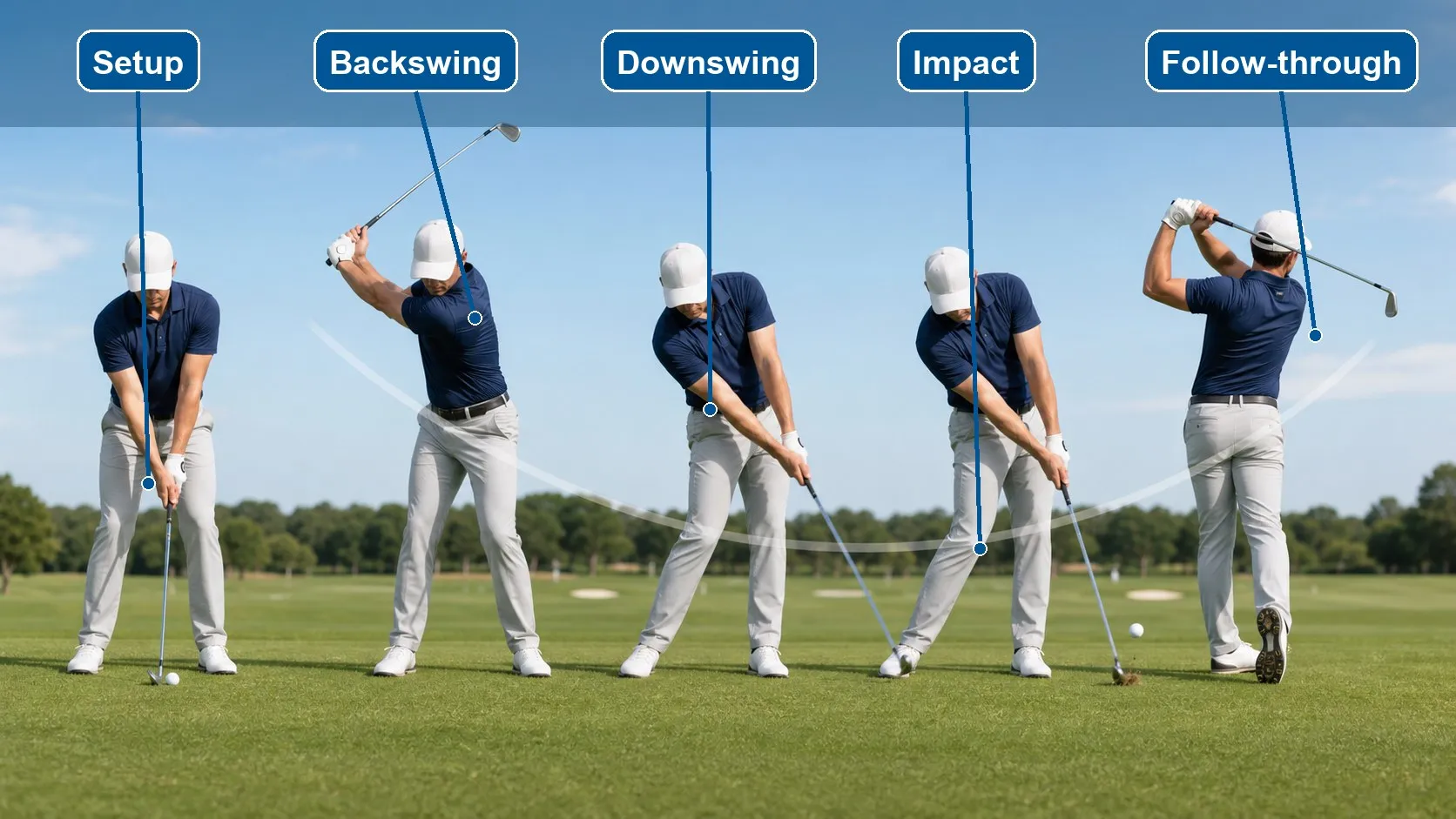
A golf swing is a complex chain of movements from the moment the club is placed behind the ball until the balanced finish. Understanding each term helps golfers learn from coaches and self-analyze swing flaws on video.
Setup / Address
According to R&A and PGA rules, Setup (or Address) is the state where the player has completed positioning their stance, placed the clubface just behind the ball, and held the clubhead motionless in preparation for the stroke. A proper setup consists of 5 core elements: stance, posture, grip, alignment, and ball position. Even a small error at this stage will compound into major swing faults.
Grip Types
Overlap (Vardon Grip): The little finger of the trailing hand overlaps between the index and middle fingers of the lead hand. The most popular grip among professional players due to its ability to synchronize both hands.
Interlock Grip: The little finger of the trailing hand and the index finger of the lead hand interlock. Ideal for players with smaller hands — used by both Tiger Woods and Jack Nicklaus.
Ten-finger (Baseball Grip): All ten fingers grip the club. Provides maximum wrist leverage, suitable for juniors, women, or players with weak wrists, though it offers less directional control.
Backswing & Downswing
Backswing is the phase of taking the club back and upward from takeaway to the top of the swing. It includes: takeaway (initial movement), coil (body rotation storing energy), wrist hinge (creating leverage), and lag (maintaining the wrist angle for maximum speed).
Downswing is the motion bringing the club from the top to the ball. It includes: transition (brief change of direction), weight shift (moving weight to the front foot), hip rotation (opening the hips), and shallowing (flattening the club path). Common fault: casting — releasing the wrist angle too early, destroying lag and reducing power.
Impact & Follow-through
Impact is the moment the clubface strikes the ball. Key factors: compression (downward attack angle), ball-first contact (the divot must land in front of the ball), and smash factor (ball speed divided by clubhead speed, max ~1.50 for driver).
Follow-through is the natural continuation after the ball leaves the clubface, ending in a finish position with the chest facing the target. This indicates whether the swing was balanced and the release (wrist unhinging) was natural.
2. Shot Types
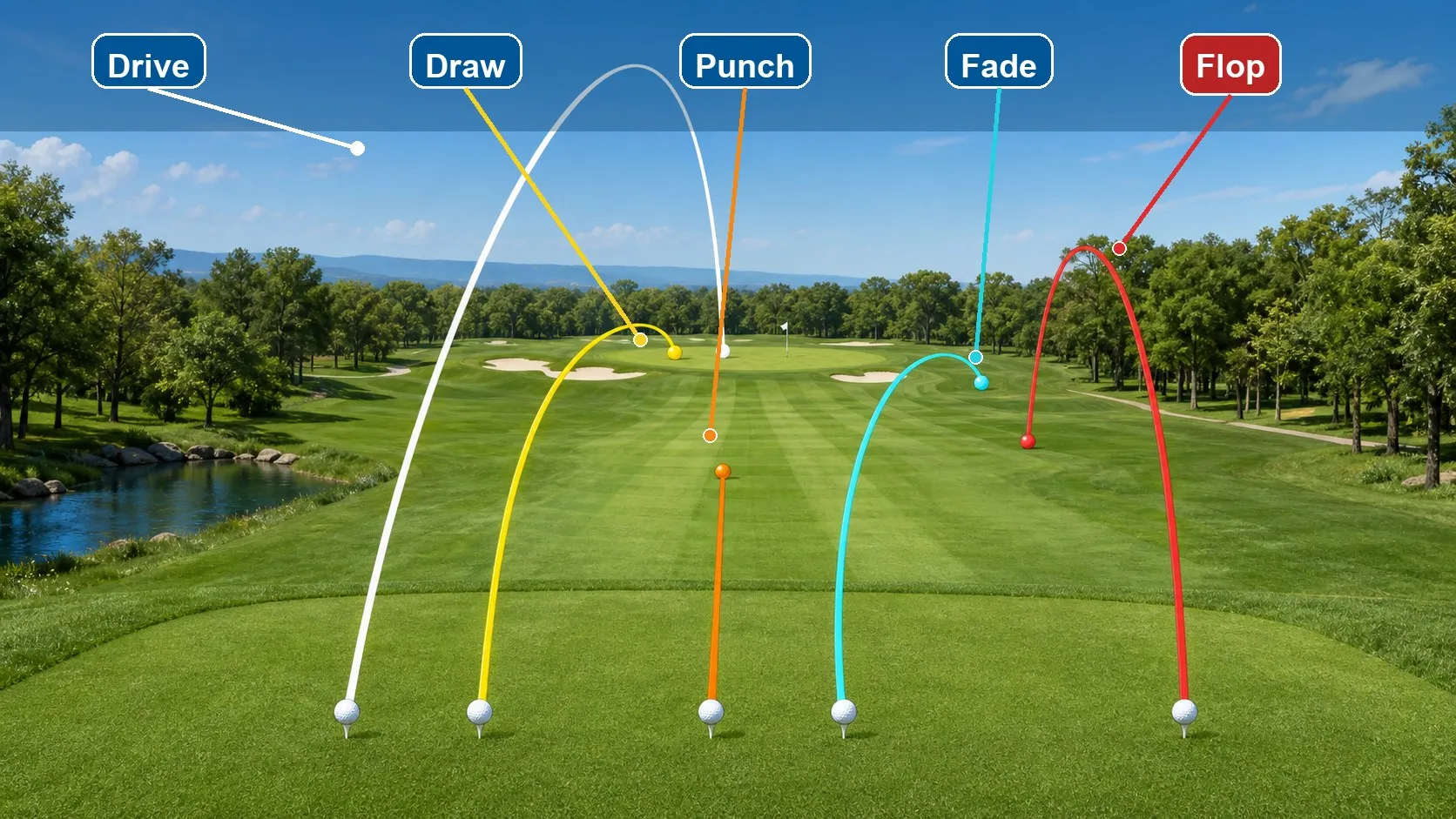
Mastering different shot types allows golfers to handle diverse situations on the course — from long drives on the fairway to escaping bunkers or punching low shots through wind.
Hook vs Slice — Common ball-flight errors
Hook is an uncontrollable sharp curve to the left (for right-handers). Main cause: grip too strong, hands too active causing the clubface to close excessively at impact. Slice is a spinning curve to the right — the most common amateur fault, usually caused by an outside-in club path with an open clubface. Both occur most frequently with the driver due to its long shaft being harder to control.
3. Short Game Terminology
Short game — shots within 100 yards of the green — directly determines your score. No matter how far you drive, without solid chipping and pitching skills, your score will quickly balloon.
Three common chip faults
Chunk: Hitting the ground before the ball, killing momentum. Cause: releasing the wrists too early. Thin: Hitting the top of the ball, sending it scooting across the green. Cause: lifting the body too early. Fluff: The club slides under the ball in thick grass without moving it. Cause: thick grass or decelerating through impact.
4. Putting Terminology
Putting accounts for roughly 40% of total strokes in a round of golf. Understanding these terms helps you read greens accurately and control putt speed.

Read the green: The process of observing and analyzing the putting surface to predict ball direction and speed. Golfers often kneel behind the ball to assess slope, water drainage direction, and grass color to determine grain (grass growth direction).
Break: The curvature of a putt caused by gravity on sloped terrain. Golfers must aim above the hole on the high side so the ball can curve down toward the cup.
Lag putt: A long putt (typically beyond 30 feet / ~9 meters) aimed at controlling speed so the ball finishes within 2–3 feet of the hole. This is the most important skill for avoiding three-putts (taking three putts to hole out).
Speed / Stimp: Green speed measured with a Stimpmeter. In Vietnam, Northern greens usually run 6.5–8.5 feet, while Central & Southern greens reach 7.0–9.5 feet. Higher stimp means faster greens and requires a softer touch.
Yips: An involuntary mental state causing sudden hand and wrist spasms during putting or short chipping. Remedies include the Claw Grip or using a longer Arm-lock putter.
5. On-Course Terminology
Understanding course layout and rules terminology helps golfers handle situations correctly and avoid costly penalties.
6. Equipment & Club Terminology
Understanding club specifications helps golfers choose equipment that matches their playing style and optimizes every shot.
7. Key Performance Statistics
These metrics help golfers measure progress and benchmark against professional players.
8. Frequently Asked Questions
What's the difference between a chip and a pitch?
Chip flies low and rolls a lot (~1/3 air, 2/3 roll), using a 7–9 iron or PW. Pitch flies higher (~2/3 air, 1/3 roll) with heavy backspin to stop quickly, using a SW or LW. Choose a chip when the green is wide and flat; choose a pitch when you need the ball to stop fast or clear an obstacle.
I keep slicing — how do I fix it?
Slicing is usually caused by an outside-in club path combined with an open clubface at impact. Quick fixes: (1) Use a stronger grip (rotate your right hand slightly to the right); (2) Practice swinging with the feeling of moving the club from inside to outside through the ball; (3) Check your setup — make sure shoulders and hips are parallel to the target line, not aimed directly at the target.
Is a Stimp 8.5 fast or slow?
Stimp 8.5 is considered moderately fast for Vietnam conditions. Classification: slow (6.0–7.0), medium (7.0–8.5), relatively fast (8.5–9.5), very fast (9.5–11.0+). Many Central and Southern Vietnamese courses run 8.5–9.5 in the dry season. The higher the stimp, the farther the ball rolls with the same putting stroke.
High bounce vs low bounce wedge — which should I choose?
High bounce (12–14°) suits soft sand, wet turf, and fluffy lies — the club bounces rather than digging in. Low bounce (4–8°) suits hard sand, dry turf, and firm fairways — prevents the club from bouncing too hard and blading the ball. If you play a variety of courses, a medium bounce of 8–10° is the safest all-around choice.
I three-putt too often — what should I practice?
Three-putting usually stems from poor distance control on lag putts rather than direction. Spend 80% of your putting practice on speed control: set a goal to stop the ball within a 3-foot circle around the hole from distances of 15, 25, and 35 feet. Only 20% of your time should go to short putts (3–6 feet). Amateur three-putt rates are typically 3–4 times higher than PGA Tour professionals.
9. Quick Reference Table
Use this table as a quick lookup when you encounter an unfamiliar term on the course or while watching a PGA Tour broadcast.
🏌️ Need help choosing the right golf course for practice?
Wingolf supports tee time bookings at over 50 golf courses nationwide — from beginner-friendly courses like West Lakes to challenging championship layouts like Montgomerie Links. Call +84 985 092 088 for personalized itinerary planning and golf tour recommendations.
— WinGolf Editorial Team
References: R&A Rules of Golf 2023-2026, USGA, PGA Tour Stats 2025-2026, TrackMan Data. All statistics are based on publicly available PGA Tour data and may vary by season.